
What is a DTF gang sheet?
A gang sheet is one length of DTF film holding many designs, printed in one run.
Why gang sheets matter
Packing designs tightly saves film and ink. The tighter the layout, the cheaper each transfer.
Laying one out
- Set the film width
- Leave a small gap between designs
- Turn pieces where it saves space
- Keep a list of which order each piece belongs to
A gang sheet in plain terms
In DTF printing, you print designs onto a roll or sheet of film, then powder, cure and press them. A gang sheet is a single length of film that holds many designs side by side, printed in one go. Those designs might be several copies of one logo, different sizes of the same design, or artwork from many different orders. The word gang comes from the old printing idea of ganging up several jobs on one sheet to save material and time.
Why printers use gang sheets
- Less wasted film. Empty film still costs money, so every gap you fill lowers the cost per transfer.
- Fewer print runs. One long sheet prints faster than many short ones, with less setup and handling.
- Lower prices for customers. Buyers who supply a full sheet get more transfers for their money.
- Easier logistics. A sheet of small designs for one order travels and stores well until pressing.
Common sheet sizes
The width of a gang sheet depends on the printer's film. Desktop DTF printers usually use A3 or roughly 30 cm wide film. Wider roll-fed printers use film around 60 cm wide; in the US, sheets of 22 inches wide are common. Length is usually flexible on a roll, so sellers offer set lengths, such as half a metre, one metre or a few feet, or charge by the length used. Check your own printer and film before you publish sizes, since usable print width is often a little less than the film width.
How gang sheets are priced
Most DTF sellers price gang sheets by size: a set price for each sheet length, or a price per metre or per foot. The customer fills the sheet with whatever designs they like. This is simple for everyone and rewards customers who pack their sheets well. Some sellers price individual transfers by size instead and gang them up behind the scenes. Whichever you choose, your price per sheet must cover film, ink, powder, machine time, maintenance, labour and packing, plus your margin.
Preparing artwork for a gang sheet
- Use PNG files with a transparent background. Anything that is not transparent will print, including white boxes around logos.
- Set the artwork to the size it will print, at around 300 DPI at that size.
- Remove semi-transparent pixels and soft shadows where you can. Faint pixels can print as a rough halo.
- Make thin lines and small text thick enough to hold up when pressed and washed.
- Check colours. Bright screen colours may not print exactly the same on film.
Laying out a gang sheet by hand
Many printers start by laying out sheets in design software. Set a document at the printable width and the sheet length. Place the largest designs first, then fill the gaps with smaller ones. Leave a small, even gap between designs so they are easy to cut apart; many printers use a few millimetres. Rotate pieces where it saves space, as long as the customer does not mind the orientation. Keep track of which design belongs to which order, because a full sheet can hold work for many customers.
Gang sheet builders
Laying out sheets by hand is slow once volume grows. There are two common kinds of tool that help. A customer-facing gang sheet builder lets the buyer upload designs, set sizes and arrange them on a sheet before ordering. It is popular with transfer sellers, because the customer does the layout. An automatic builder works on the shop's side: it takes the print files from approved orders and packs them onto sheets for you. This suits shops that print finished garments from many orders each day, since nobody has to arrange the sheets.
Gang sheets for selling transfers
If you sell transfers to other decorators, say clearly what a sheet includes: its printable width and length, the file type you accept, and whether you will resize or check artwork. Show a sample layout so buyers know how much fits.
Avoiding common gang sheet problems
- Designs too close together, making them hard to cut and easy to damage.
- Missing a design because nobody tracked which orders were on which sheet.
- Printing the same sheet twice after a mix-up, wasting film and ink.
- Low-resolution files that look fine small on screen but print blurry.
- Ignoring the unprintable margin at the film edges.
A simple habit helps with most of these: give every sheet a reference, print a cover list of the orders and designs it holds, and mark sheets as printed as soon as they come off the printer.
Cutting and pressing after printing
Once the sheet is cured, cut the designs apart with scissors or a trimmer, leaving a small border of film around each one. Store transfers flat, away from heat and damp. Press each one at the time, temperature and pressure the film supplier recommends, and peel hot or cold as the film requires. Some printers re-press for a few seconds with a cover sheet to improve wash durability and give a softer finish.
Gang sheets in Dyenzo
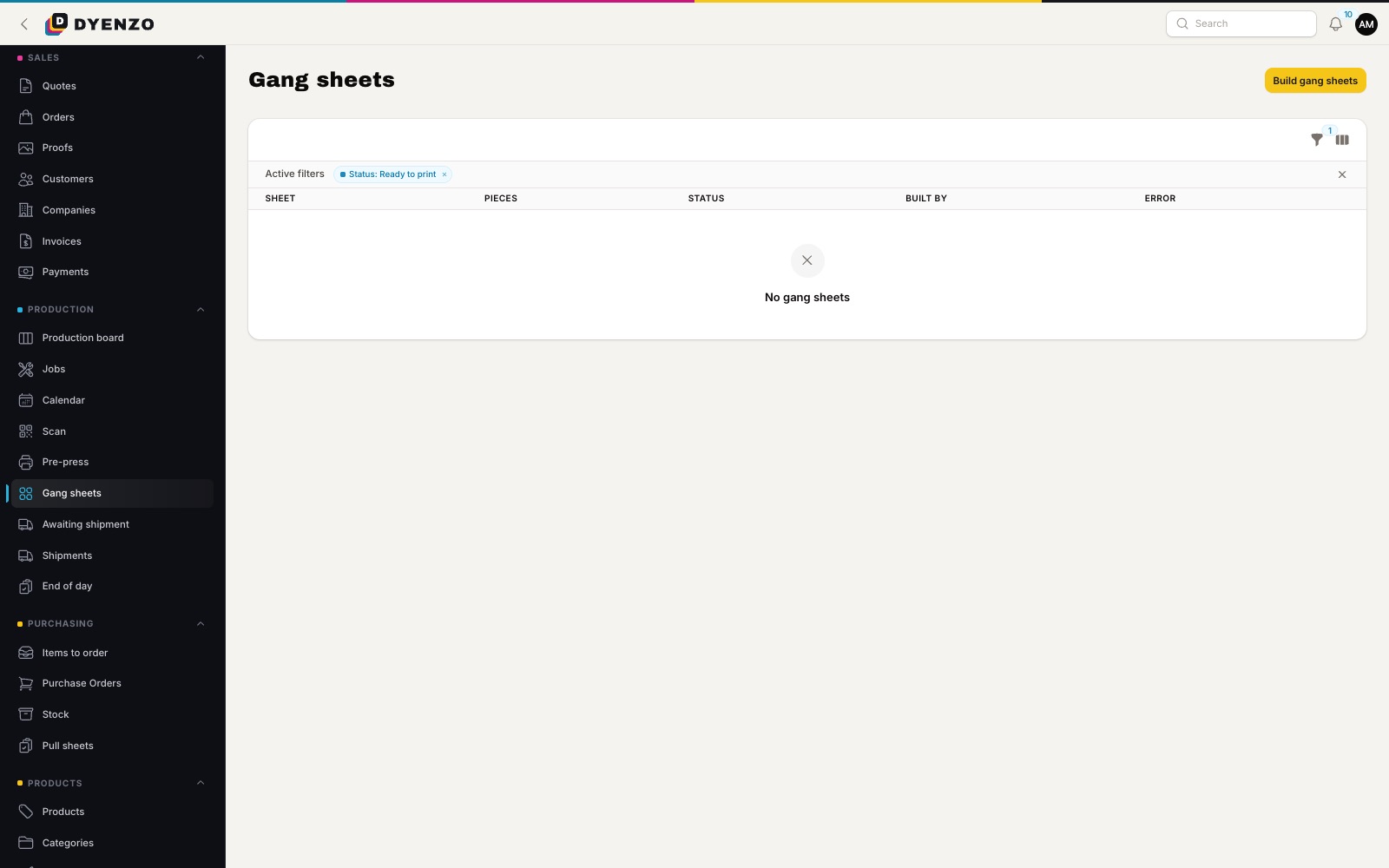
Dyenzo builds gang sheets automatically. It packs every released print file onto sheets at your film width, with the gap you set and turns only where you allow them, the same layout every time. You download the sheet PDF and a cover list of orders, and mark sheets printing and printed so nothing prints twice.
Questions
How many designs fit on a gang sheet?
It depends on the sheet size and the size of each design. Small logos can fit dozens on a short sheet, while full-front designs may fit only a few across the width.
Can one gang sheet hold designs from different orders?
Yes. Shops often mix orders on one sheet to save film. Keep a list of which design belongs to which order so nothing goes missing.
What file type is best for a gang sheet?
A PNG with a transparent background at around 300 DPI at the printed size is the common choice.
Do I need software to make gang sheets?
Not at first; design software works for a few sheets a day. Once volume grows, a gang sheet builder saves time and mistakes.
Dyenzo is opening to its first print businesses
Write to us for early access. Tell us what you print and which modules you need.