
How to start a DTF printing business
DTF lets you print full colour from one piece. Here is how to make it pay.
Fill every sheet
Film is your biggest running cost. Gang sheets that pack many orders together keep waste low.
Sell transfers and finished garments
Sell ready-to-press transfers to other decorators as well as finished garments to your own customers.
What DTF printing is
DTF stands for direct to film. You print a design in CMYK plus a layer of white ink onto a special PET film. While the ink is wet, you cover it with a hot-melt adhesive powder, shake off the excess and cure it with heat. The result is a transfer you can press onto a garment with a heat press, or store and press later. DTF works on cotton, polyester, blends and many other fabrics, on light and dark colours, with no weeding and no screens. That makes it a good fit for short runs, full-colour designs and one-off personalised pieces.
Two ways to run a DTF business
Most DTF businesses do one or both of these:
- Sell finished garments: you print the transfer and press it on the shirt, hoodie or bag yourself, and sell the finished product to clubs, businesses and the public.
- Sell transfers: you print transfers, often on gang sheets, and sell them to other decorators, crafters and small brands who press them on their own garments.
Selling transfers means more volume and less handling of garments, but the market is competitive and customers compare prices closely. Selling finished garments gives better margins per order, but you need to buy blanks, press and pack. Many shops start with finished garments and add transfer sales once the printer is busy.
The equipment
- A DTF printer. Options range from small desktop printers using A3 or roughly 30 cm film to wider roll-fed printers using film around 60 cm wide. Some people convert a standard inkjet; a purpose-built printer is usually more reliable for business use.
- RIP software to control the white layer, colour and ink use. It often comes with the printer.
- A powder shaker and dryer, or a manual powder tray and a curing oven for smaller setups.
- A heat press with even heat and pressure. A larger platen helps with hoodies and adult sizes.
- Film, DTF inks and adhesive powder from a supplier you trust.
- Fume extraction or good ventilation for the curing stage.
Prices vary widely between desktop and roll-fed setups. Check current prices with several suppliers, ask what support and training they give, and find out how easy it is to get spare print heads and parts.
Running costs to watch
The printer is a one-off cost, but film, ink and powder are spent on every job. Film is often the biggest share, which is why packing designs tightly on gang sheets matters so much. White ink needs daily care: it settles and can clog heads if the printer sits idle. Most printers need a short maintenance routine every day and a deeper clean every week. Allow for print head replacements, wasted film from test prints, and electricity for the dryer and press.
Getting quality right
- Ask customers for high resolution artwork, ideally 300 DPI at the printed size, with a transparent background.
- Watch for semi-transparent pixels and soft edges. They print as a faint halo or rough edge.
- Run test prints on each new film, powder or ink, and keep the settings that work.
- Follow the film supplier's pressing time, temperature and pressure, and whether the film is hot peel or cold peel.
- Do wash tests and stretch tests on new garments before you sell them.
Pricing DTF
Price finished garments as the blank cost with your markup, plus a transfer charge per print location that covers film, ink, powder, press time and handling. Larger designs use more film and ink, so many shops price transfers by size bands, such as small, medium and full front. Price gang sheets by length or by a fixed sheet size. For transfers sold to other decorators, work out your cost per metre or per foot of printed film, then add your margin. Charge more for rush orders and for artwork fixes.
Gang sheets
A gang sheet is one length of film holding many designs printed in one run. Filling every sheet keeps your cost per transfer down. You can lay out sheets yourself in design software, let customers build their own sheets online, or use software that builds them from your orders. Our guide on what a DTF gang sheet is covers layout in detail.
Register the business and handle tax
In the UK, register with HMRC as a sole trader or set up a limited company at Companies House. You must register for VAT once your taxable turnover passes the threshold in a rolling 12 months; check the current figure on GOV.UK. If you sell transfers online to customers in other countries, check the VAT and customs rules for those sales.
In the US, register a sole proprietorship or LLC, get an EIN from the IRS, and get a sales tax permit in your state. A resale certificate lets you buy blanks for resale without paying sales tax. Online sales into other states can create sales tax obligations there once you pass a state's thresholds, so check the rules as you grow.
Whatever you print, make sure you have the right to print the designs. Customers sometimes upload logos and characters they do not own. Have clear terms that they confirm they hold the rights, and say no to work you know is infringing.
Finding customers
- Local clubs, schools, small businesses and events that need short runs in full colour.
- Other decorators who want full-colour transfers without buying a DTF printer.
- Small clothing brands and online sellers who need reliable transfer supply.
- Your own website with an upload form or online designer, and social media posts showing real pressed garments.
Where Dyenzo fits
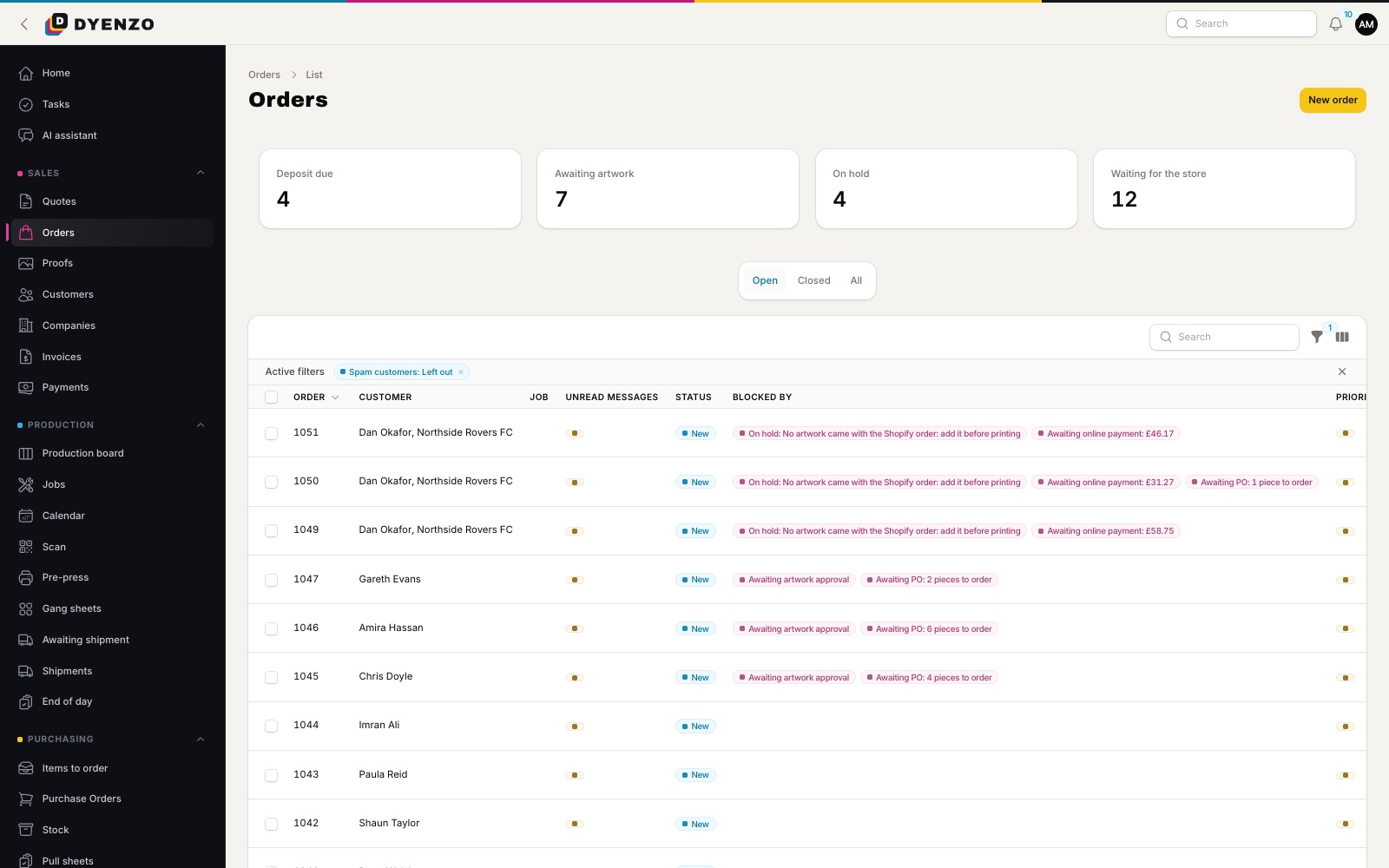
Dyenzo takes orders from your website, stores and Shopify, checks each design is ready to print, and builds gang sheets from released print files at your film width, with the gap you set. It makes the sheet PDF and a cover list of orders, and marks sheets printing and printed so nothing prints twice.
Questions
Is DTF better than screen printing?
Neither is better for everything. DTF is cheaper for short runs and full-colour designs because there are no screens. Screen printing is usually cheaper per piece for larger runs of simple designs.
How long do DTF transfers last?
Pressed correctly with good film, ink and powder, DTF prints stand up well to regular washing. Follow the supplier's press settings and do your own wash tests.
Can I sell DTF transfers without pressing them?
Yes. Many DTF businesses sell ready-to-press transfers to other decorators and crafters. Include clear pressing instructions with every order.
What film width should I choose?
Desktop printers usually take A3 or roughly 30 cm film. Wider roll-fed printers take film around 60 cm wide, which suits larger gang sheets and higher volume.
Dyenzo is opening to its first print businesses
Write to us for early access. Tell us what you print and which modules you need.